
Decided to take a trip to Boise, ID for the long weekend. (well I left on Sunday so I guess it really just a regular weekend in this regard…) Here’s some flight planning bits that hopefully is useful to some:
Route Selection
There are a couple “standard options” to go from Bay Area to Boise.
The “Direct” Route
Basically what it sounds like: say KPAO REO KBOI. This route is about ~450nm, it does avoid most of the MOA around Boise. However, this is also the least populated route. There’s nothing between Reno, NV and Rome, ID. If your plane happened to have an emergency, you will most likely have to land in the desert and who knows how long until rescue came to you. This is my return route.
Slightly Better Variation: Winemucca Route
A slightly better alternative would be KPAO KRNO KWMC SDO REO KBOI, at ~485nm. This is my outbound route. (You don’t need to actually fly over KWMC, I setup my GPS to go KRNO SDO, you will still fly close enough to KWMC for a diversion)
You will be following I-80 so at least there are always some people around and you have a larger airport in the middle should anything happened.
The Long Way
This involves us to fly north through Central Valley and fly through Klamath Falls, clocking ~560nm. This will add at least 40mins to flight time and it will take you through a few MOAs. (To completely going around them will take another 20 mins.) This route however does take you through much more populated areas, minimizing wilderness while also skipping the Sierra mountain. If you do not feel comfortable about crossing the Sierra mountains, this would be the best route.
Crossing the Sierra Mountains
The Sierra Mountains is what gives us the beautiful Yosemite, Lake Tahoe and Mammoth Lakes. However, it is also a huge divider between California and Nevada. It will frequently pushing up towards the oxygen required altitude (per 91.211) as a lot of MEFs are already around 11000ft, some are even higher.
A popular path is to fly past Sacramento and fly IFR (I Follow Roads), follow the I-80 past Truckee and into Reno. Make sure you know about mountain flying and watch out for strong winds as it could get amplified and translated into strong up/down drafts by the ridges.
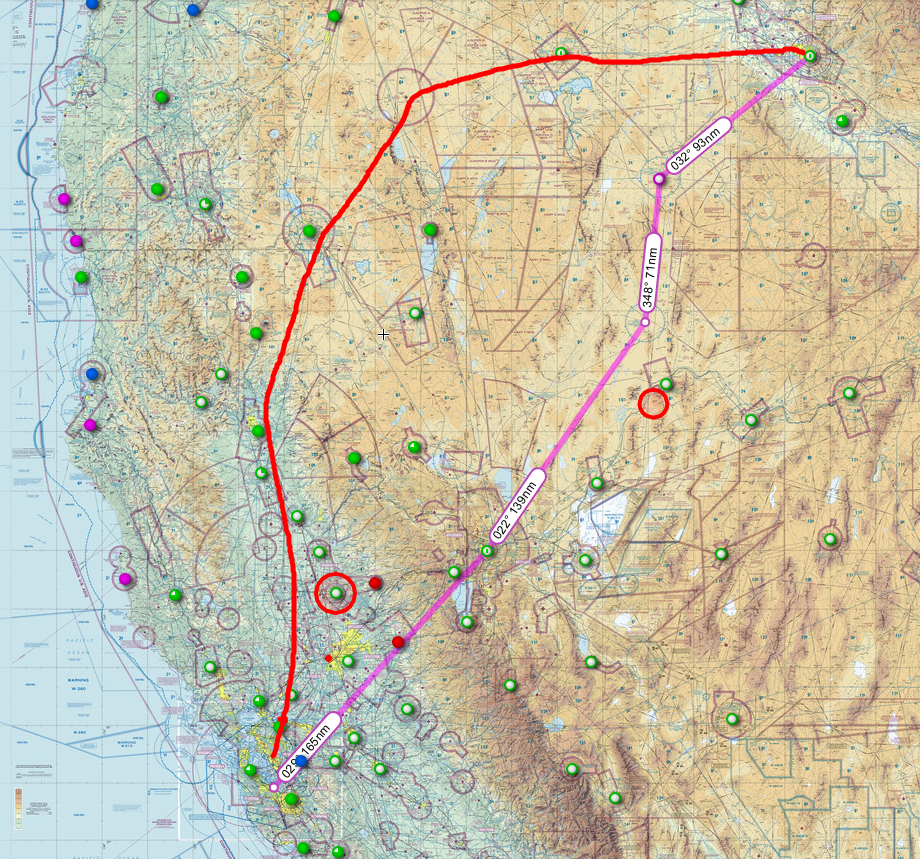
My Selection
The Long Way is the first one out as it really adds a lot of flying time going the wrong way. I feel comfortable making the crossing and chose the Winemucca route.
On the return journey, partly because I want to try the PDC out and filed IFR. The direct route is pretty much one of the pre-cleared route so I opt with it. If you do fly the direct route, please make sure you have emergency equipment and at minimal, get flight following so you’re in the systems being tracked.
If you choose to fly IFR (the actual rule one), you will probably need to fly pretty high, while it is possible to fly it below 12,500ft. I would still highly recommend that you do fly that in an airplane with actual oxygen system.
Radar / Radio Communications
One of the larger issue with flying over Nevada desert is that there’s absolutely nothing out there. You’re almost always pretty far away from civilization and it also means radar and radio coverage as well.
NorCal all the way up to Reno had excellent reception and Big Sky (Boise) was also great. It is when you fly past Reno the problem starts to show. On my outbound flight, I took the south path, fly basically from Reno to SDO. Around Winnemucca, I noticed I can’t here Oakland / Salt Lake Center as well as earlier, their call starts to intermittently drop. I had to disable squelch completely (on a G1000, you can do this by push-in the volume button and the frequency will display SQ) which is extremely annoying for quiet a bit. It got better past Rome VOR, but it was about 20mins of white noise attack.
On return, I flew almost direct (basically similar to the REO — SDO leg but on the other side of mountain), I had have a few mins of radar contact lost and the radio communication was spotty as well. This time I was able to use manual squelch to get it to be under controlled better but I would really prefer to have proper radar / radio coverage around these parts.